
Chris Hillman
Thursday, November 26, 2026
Retro Kart - A Print-and-Play Racing Retrospective
A 60-minute sprint retrospective you print, cut up and tape to a wall. The sprint was a race, and the team watches the replay.
What You’re Getting
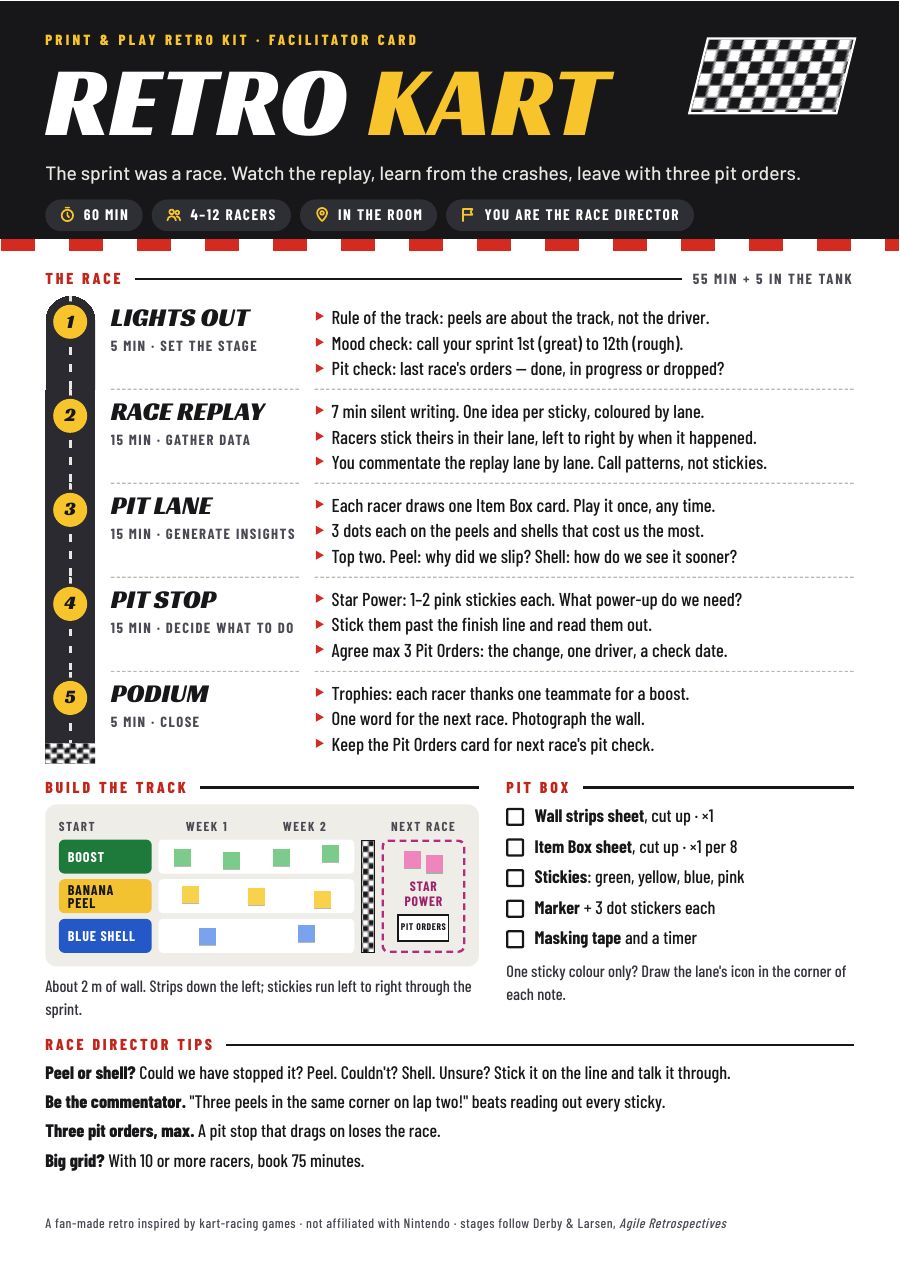
Retro Kart is a whole retrospective on three sheets of A4. Three strips taped down the left of a wall make the lanes, and a fourth goes just past the finish line. The team fills the lanes with stickies in the order things happened, votes on what cost the most, and leaves with no more than three Pit Orders, each with one driver and a date to check it.
The questions are the ones any retro asks, sorted differently. A Banana Peel is something that tripped you up and could have been avoided. A Blue Shell is something that hit you out of nowhere and couldn’t. The two get different questions in the Pit Lane. For a peel: why did we slip? For a shell: how do we see it sooner?
When nobody can agree which one it is, the facilitator card has the tiebreak. Stick it on the line between the two lanes and talk it through.
How the Hour Runs
| Stage | Time | What happens |
|---|---|---|
| Lights Out | 5 min | The rule of the track (peels are about the track, not the driver), a mood check from 1st to 12th, and a check on last race’s Pit Orders: done, in progress or dropped |
| Race Replay | 15 min | Seven minutes of silent writing, one idea per sticky. Everyone sticks theirs in its lane, left to right by when it happened |
| Pit Lane | 15 min | Each racer draws an Item Box card. Three dots each on the peels and shells that cost the most, then the top two get a proper look |
| Pit Stop | 15 min | Star Power: one or two pink stickies each on what would help next race. Then agree up to three Pit Orders |
| Podium | 5 min | Each racer thanks one teammate for a boost and gives one word for the next race. Photograph the wall and keep the Pit Orders card |
That’s 55 minutes, with five in the tank. With ten or more racers, book 75.
Under the theme, the five stages are the five phases from Esther Derby and Diana Larsen’s Agile Retrospectives: set the stage, gather data, generate insights, decide what to do, and close.
The Lanes
| Lane | Stickies | The question |
|---|---|---|
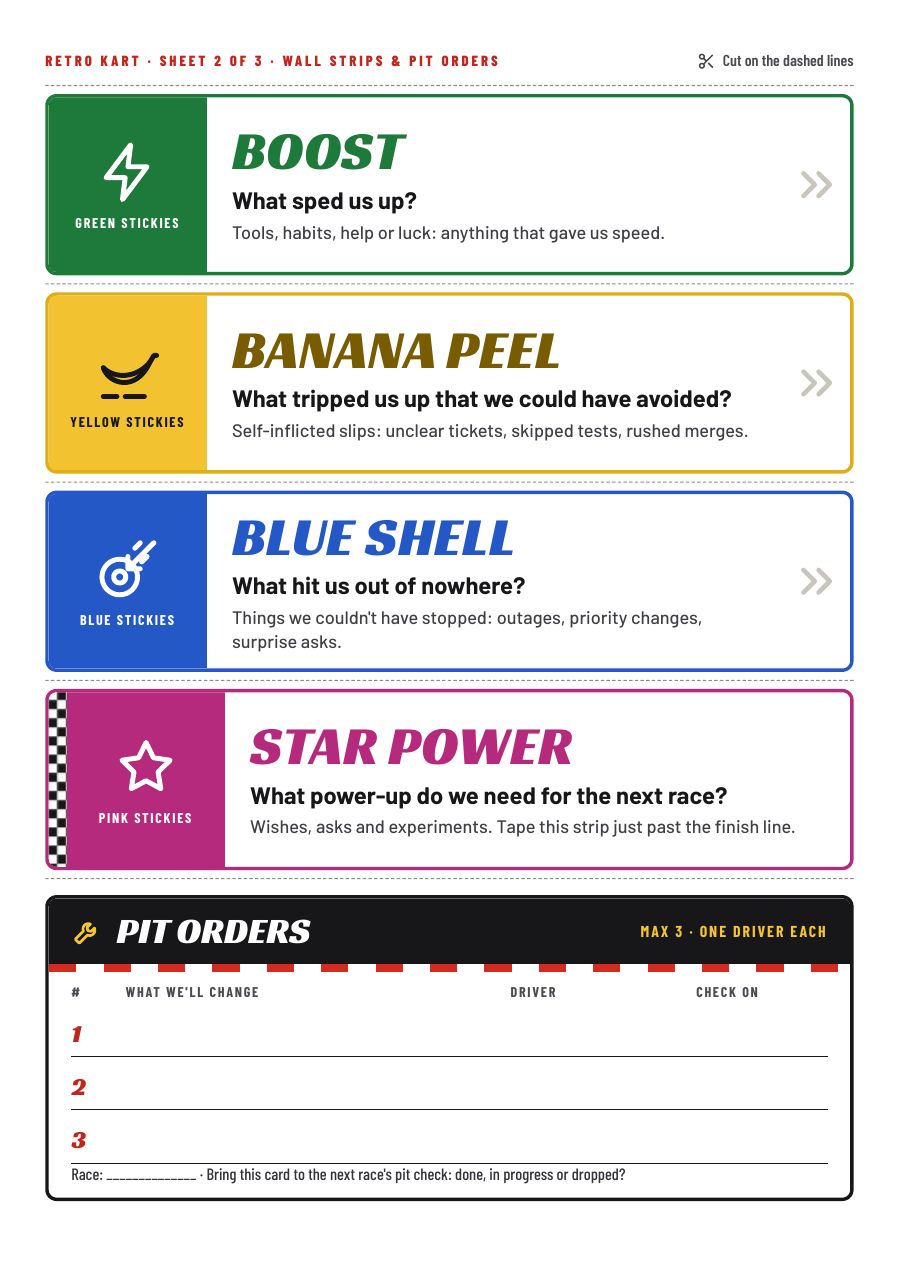
| Boost | Green | What sped us up? |
| Banana Peel | Yellow | What tripped us up that we could have avoided? |
| Blue Shell | Blue | What hit us out of nowhere? |
| Star Power | Pink | What power-up do we need for the next race? |
The first three run left to right along the wall, as a timeline of the sprint. Star Power goes just past the finish line, with the Pit Orders card.
The Item Box
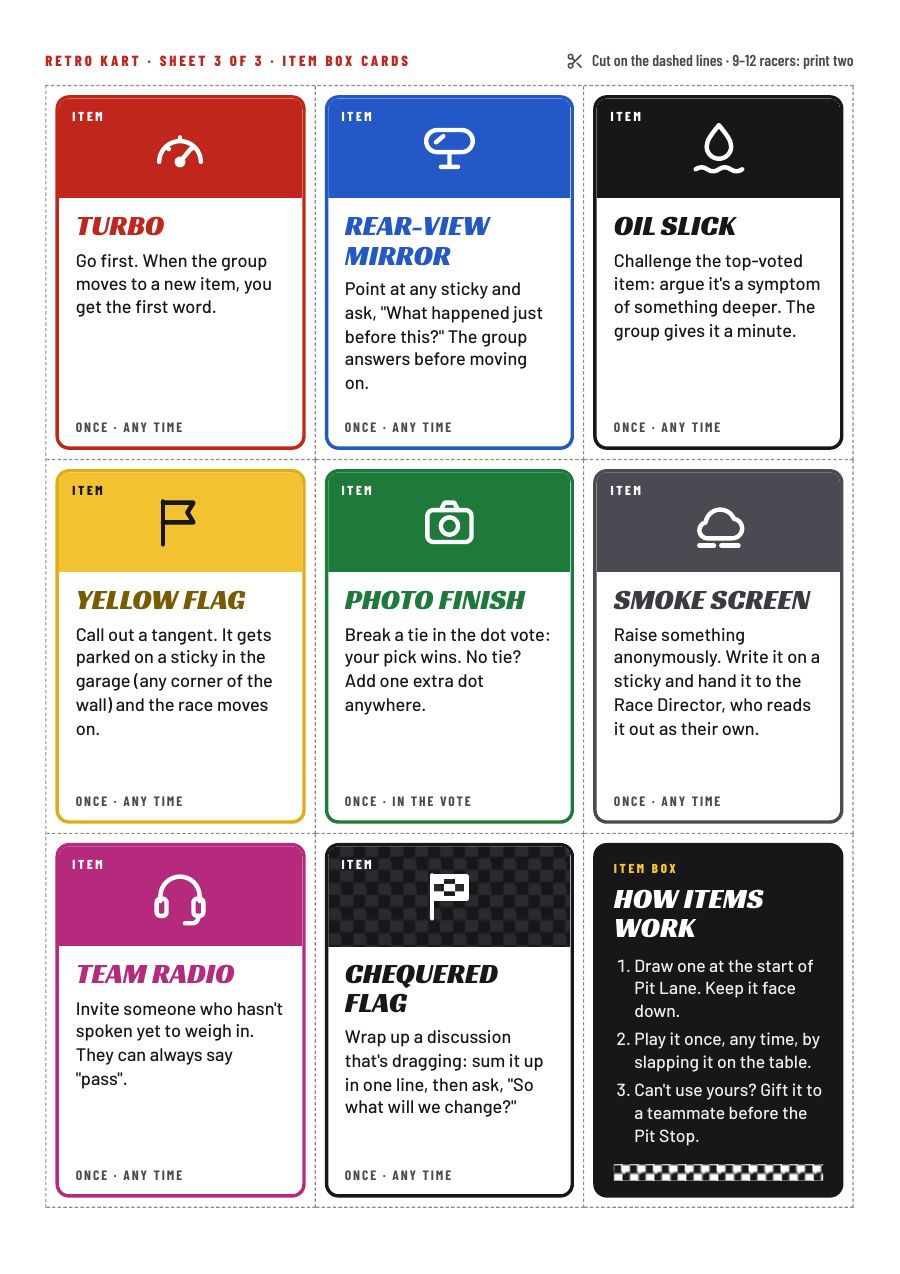
Each racer draws one Item Box card at the start of the Pit Lane and can play it once. Most of them are moves a facilitator would normally make, dealt out to the team.
| Card | What it does |
|---|---|
| Rear-View Mirror | Point at any sticky and ask, “What happened just before this?” |
| Oil Slick | Challenge the top-voted item: argue it’s a symptom of something deeper. The group gives it a minute |
| Smoke Screen | Raise something anonymously. Write it on a sticky and hand it to the Race Director, who reads it out as their own |
| Team Radio | Invite someone who hasn’t spoken yet to weigh in. They can always say “pass” |
| Yellow Flag | Call out a tangent. It gets parked on a sticky in the garage (any corner of the wall) |
| Chequered Flag | Wrap up a discussion that’s dragging: sum it up in one line, then ask, “So what will we change?” |
| Turbo | Go first. When the group moves to a new item, you get the first word |
| Photo Finish | Break a tie in the dot vote. No tie? Add one extra dot anywhere |
A card you can’t use can be given to a teammate before the Pit Stop.
What’s in the PDF
| Sheet | What’s on it |
|---|---|
| 1. Facilitator card | The five stages with timings, how to build the track, the kit list and tips for the Race Director |
| 2. Wall strips and Pit Orders | The four lane strips to cut out, and the Pit Orders card: up to three changes, one driver each and a date to check |
| 3. Item Box cards | Eight item cards and a rules card. Print two copies for nine to twelve racers |
A Look Inside
All three sheets. Click one to see it full size.
What You’ll Need
- The three sheets, with sheets 2 and 3 cut up
- Stickies in green, yellow, blue and pink
- A marker and three dot stickers each
- Masking tape and a timer
- About two metres of wall
Only one colour of stickies? Draw the lane’s icon in the corner of each note.
When It Fits
Retro Kart is for 4 to 12 people in a room with a wall.
Of the three kits it’s the closest to a retro your team already knows. The team writes stickies and votes with dots, the way they would in any retro. The only performance is the facilitator’s: the card asks the Race Director to commentate the replay (“Three peels in the same corner on lap two!”) instead of reading out every sticky.
Where It Comes From
Mario Kart retros are a well-worn idea in agile teams, mostly as online boards. Doug Idle’s Miro template is one of the most used. I didn’t know about it when I made Retro Kart, so nothing here was taken from it. This kit is print-and-play, with the lanes on a wall, the split between peels and shells, and the Item Box cards.
It’s a fan-made retro inspired by kart-racing games. It isn’t affiliated with or endorsed by Nintendo.
Download
The download goes through Payhip’s checkout, at $0. How your details are used: Privacy.
The other two kits are Dungeons & Deadlines, a scripted tabletop quest, and Retros Against Humanity, a card game with anonymous answers.
Why I made the three kits, and what games can and can’t fix in a retro: The Same Retro Gets the Same Answers.
Using It
It’s free. Print it, cut it up and run it with your team, at work included.
Please don’t sell it, or put it inside something you sell. If someone else wants a copy, send them this page.