
Chris Hillman
Wednesday, November 18, 2026
Data Engineering Interview Kit - Both Sides of the Table
What You’re Getting
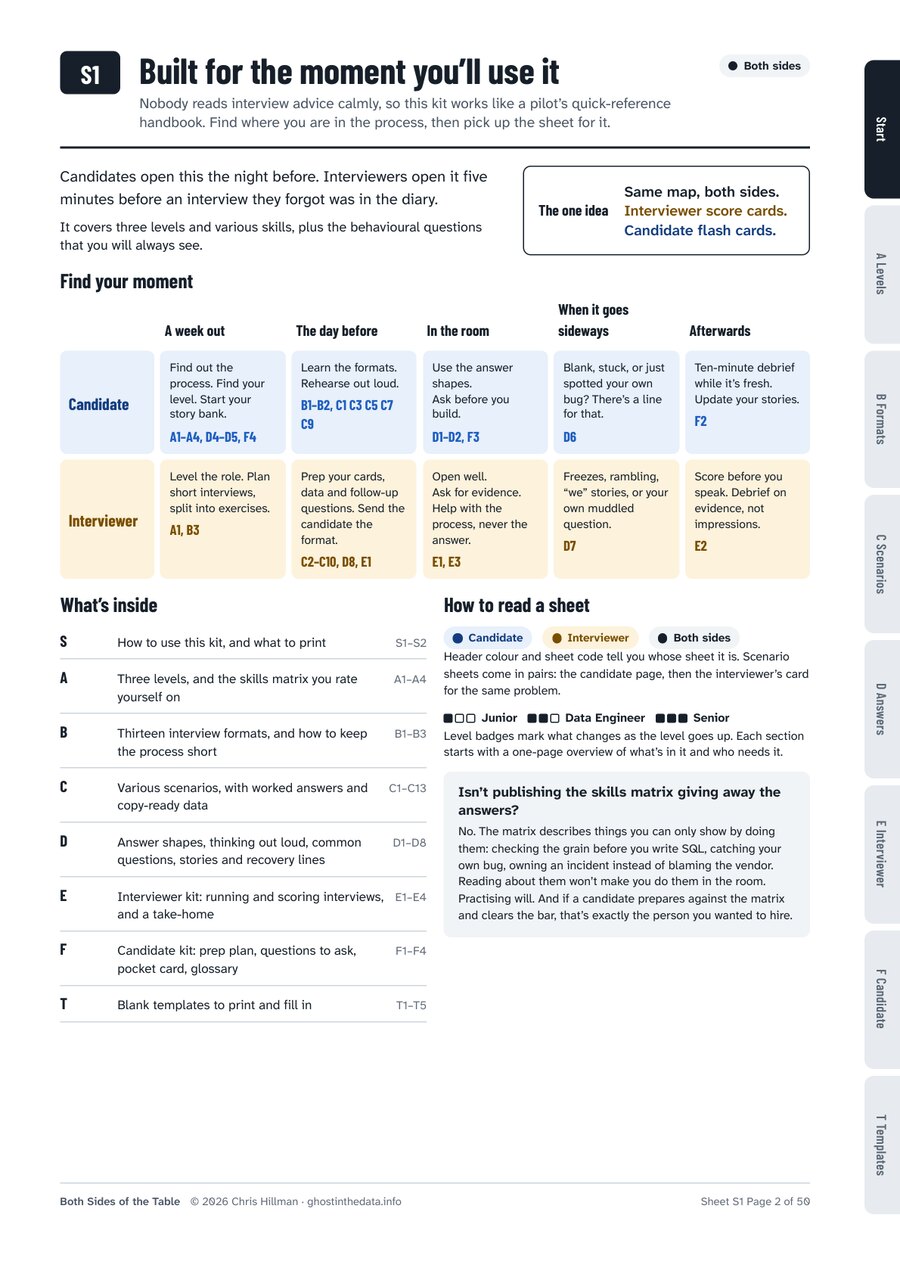
Nobody reads interview advice calmly. Candidates open it the night before with their pulse up. Interviewers open it five minutes before an interview they forgot was in the diary.
This kit is built for those moments. It’s a set of one-page cheat sheets for data engineering interviews, laid out like a pilot’s quick-reference handbook. You find where you are in the process, then pick up the sheet for it.
It covers three levels (Junior Data Engineer, Data Engineer and Senior Data Engineer) and five skills: SQL, Python, data modelling, pipeline design and working with AI. It also covers the behavioural questions, which you’ll get in every interview and which decide more offers than any of those five.
What Makes This Different
Most interview prep is written for one side of the table. This kit is written for both.
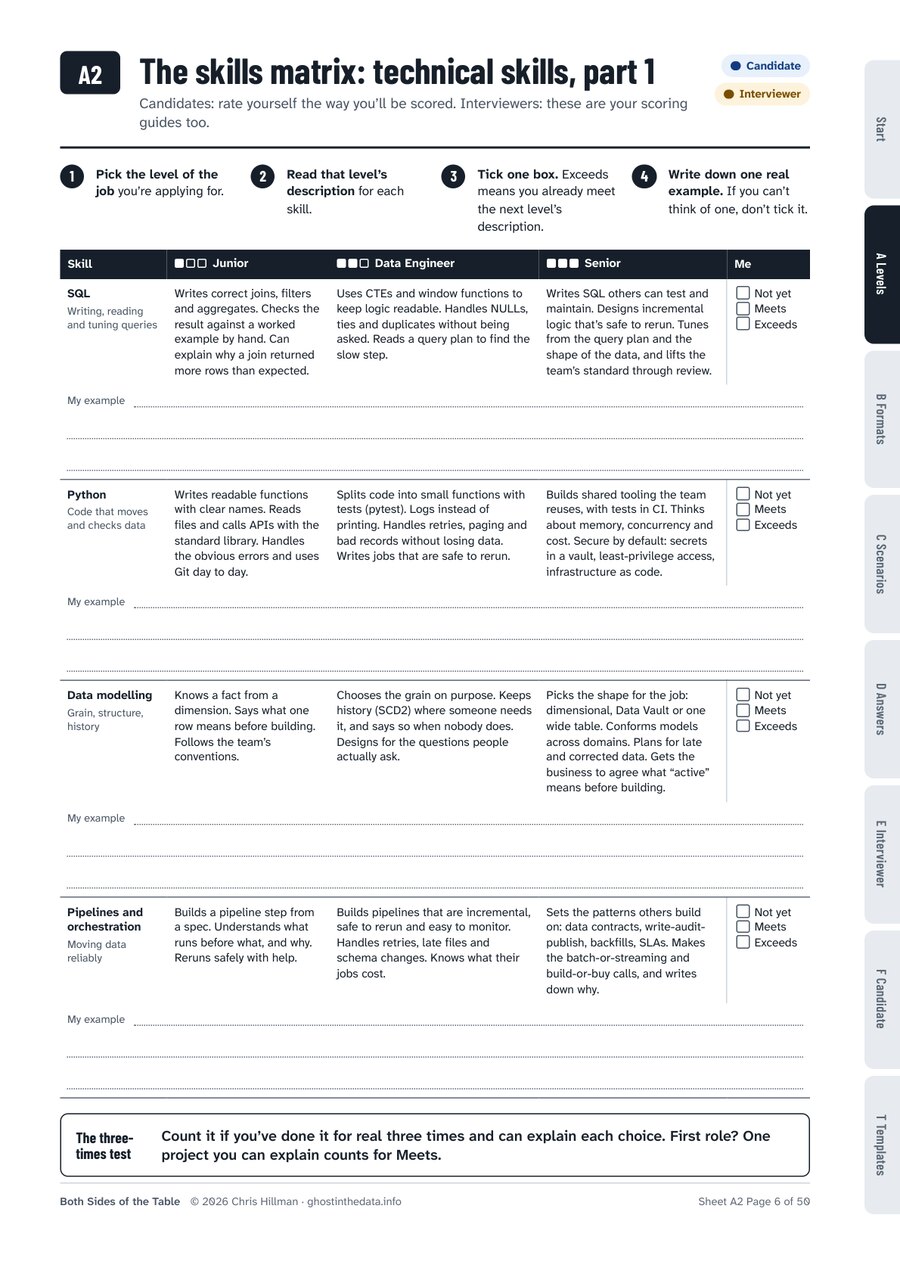
The skills matrix an interviewer scores with is the same one a candidate prepares against. Candidates rate themselves with it before the interviews, and interviewers score with it in the room.
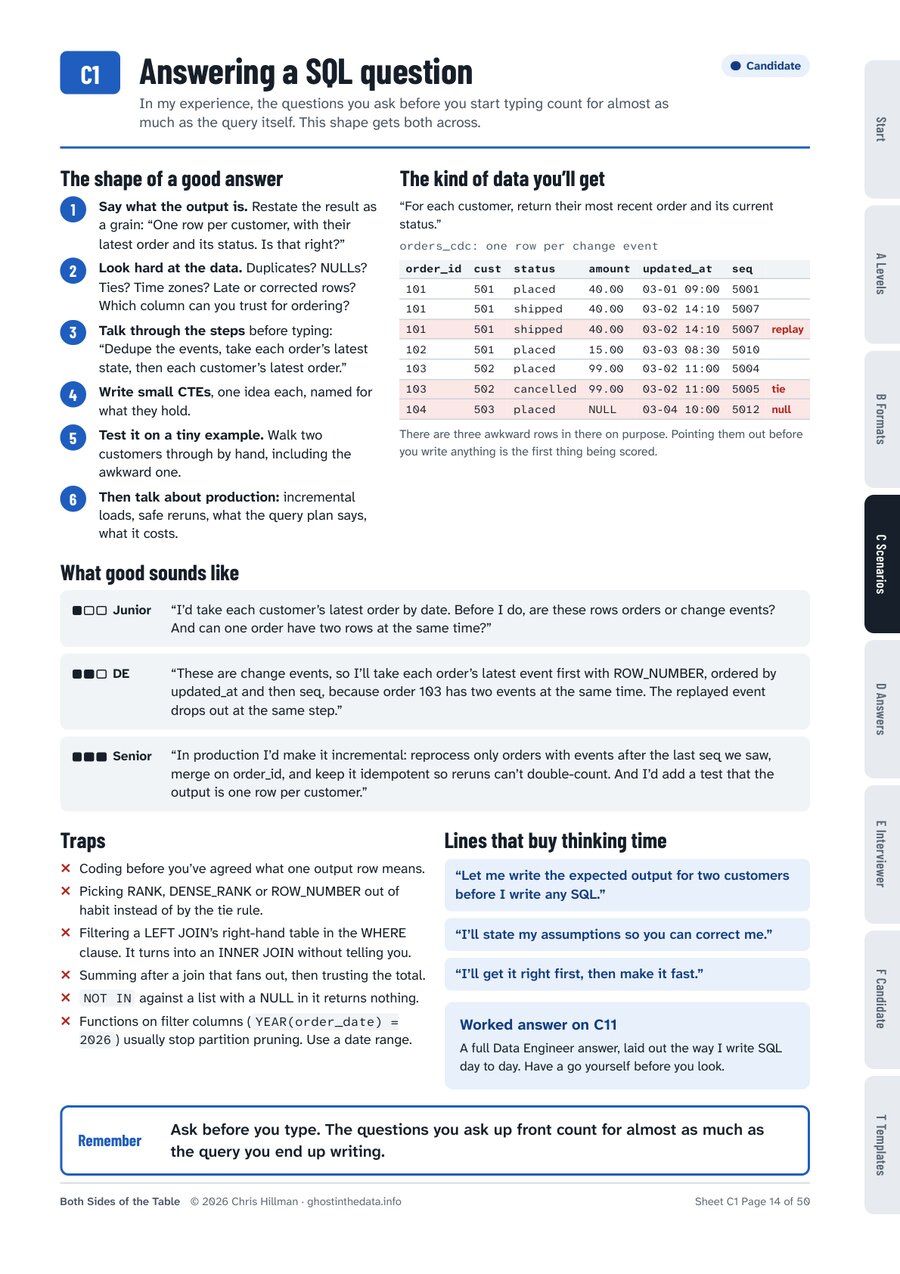
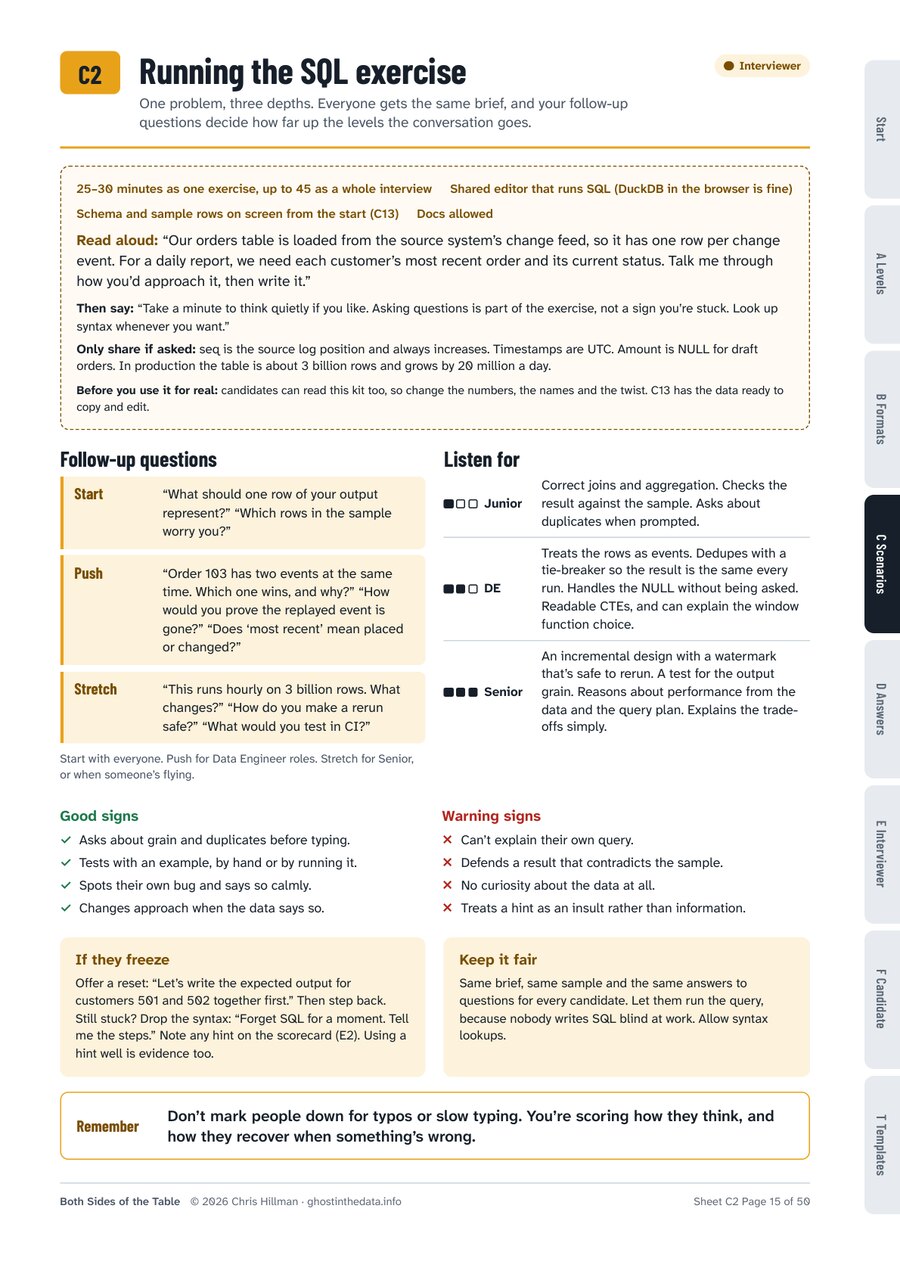
Every scenario comes as a pair. The candidate page shows the shape of a good answer and what good sounds like at each level. The interviewer card is for the same problem, with what to read aloud, what to share only if asked, the follow-up questions, and what to listen for.
Isn’t publishing the skills matrix giving away the answers? No. The matrix describes things you can only show by doing them, like checking the grain before you write SQL, catching your own bug, or owning an incident instead of blaming the vendor. Reading about them won’t make you do them in the room. Practising will. And if a candidate prepares against the matrix and clears the bar, that’s exactly the person you wanted to hire.
It also keeps the process short. Instead of one long day of interviews, each interview is built from short exercises, and each exercise scores only the one or two skills it was set up to measure.
What’s Inside
Forty-three one-page sheets in eight sections, each section opening with a one-page overview of what’s in it and who needs it.
| Section | Sheets | What’s on them |
|---|---|---|
| Start | S1–S2 | How to use the kit, and what to print |
| Levels | A1–A4 | The three levels, and the skills matrix you rate yourself on |
| Formats | B1–B3 | Thirteen interview formats, and how to keep the process short |
| Scenarios | C1–C13 | SQL, Python, modelling, pipelines and AI, each as a candidate page and an interviewer card. Worked answers and copy-ready data |
| Answers | D1–D8 | STAR and SBAR, thinking out loud, common questions, your stories, and recovery lines for both sides |
| Interviewer kit | E1–E4 | Running and scoring an interview, the debrief, a pocket card and a take-home brief |
| Candidate kit | F1–F4 | A prep plan, questions to ask, a pocket card and a glossary |
| Templates | T1–T5 | Blank scorecards, plans and prep sheets to print and fill in |
You don’t need every page. Sheet S2 splits the kit into three packs: a 12-page one for candidates, a 26-page one for interviewers, and a 26-page one for whoever is planning the interviews.
A Look Inside
Four of the 43 sheets. Click one to see it full size.
Who It’s For
Candidates going for junior, mid-level or senior data engineering roles. Rate yourself against the level of the job, build a small bank of stories, and rehearse one scenario per skill out loud. There’s a two-week prep plan, and a 72-hour one for when the call comes late.
Interviewers and hiring managers who want a fairer, shorter process. Level the role, plan short interviews split into exercises, run each one from its interviewer card, and score on evidence before anyone talks in the debrief.
Staff, principal and lead roles aren’t covered in this edition.
How to Use It
Find your moment, then grab the sheet.
| When | Candidate | Interviewer |
|---|---|---|
| A week out | Find out the process. Find your level. Start your story bank. | Level the role. Plan short interviews, split into exercises. |
| The day before | Learn the formats. Rehearse one scenario per skill, out loud. | Prep your card, data and follow-up questions. Send the candidate the format. |
| In the room | Use the answer shapes. Ask before you build. | Open well. Ask for evidence. Help with the process, never the answer. |
| When it goes sideways | Blank, stuck, or just spotted your own bug? There’s a line for that. | Freezes, rambling, “we” stories or your own muddled question. There are lines for those too. |
| Afterwards | A ten-minute debrief while it’s fresh. Update your stories. | Score before you speak. Debrief on evidence, not impressions. |
What This Costs
$27 AUD
One purchase covers both sides of the table. You get:
- 43 one-page sheets as a 50-page A4 PDF
- Three levels, five skills and thirteen interview formats
- A skills matrix with eleven skills, for rating yourself and scoring candidates
- Worked answers for SQL and Python, plus the exercise data ready to copy
- A take-home brief with a marking guide
- Two pocket cards, one for each side, to print and keep beside your laptop
- Five blank templates, from a one-interview scorecard to your own prep sheet
Purchase & Download
Click the button below to buy. You’ll get the PDF to download straight away.
Buy the Interview Kit - $27 AUD For the longer version, read Mastering Data Interviews and The Guerrilla Guide to Data Engineering Interviews on the blog.
Licence Terms
You get a personal, non-transferable licence for your own use. Print the sheets, write on them, and use them in your own interviews, whichever side of the table you’re on. That includes interviews you run at work.
What you can’t do is share the PDF publicly, redistribute it, or include it in something you sell. Think of it like a cookbook. Use the recipes all you want, but don’t photocopy the book for your friends.
Your Australian Consumer Law rights are protected.