
Chris Hillman
Thursday, November 26, 2026
Dungeons & Deadlines - A Tabletop Quest for Your Sprint Retrospective
A sprint retrospective run as a tabletop quest. Your team are adventurers back from the sprint, you’re the Dungeon Master, and the script gives you every line to read.
What You’re Getting
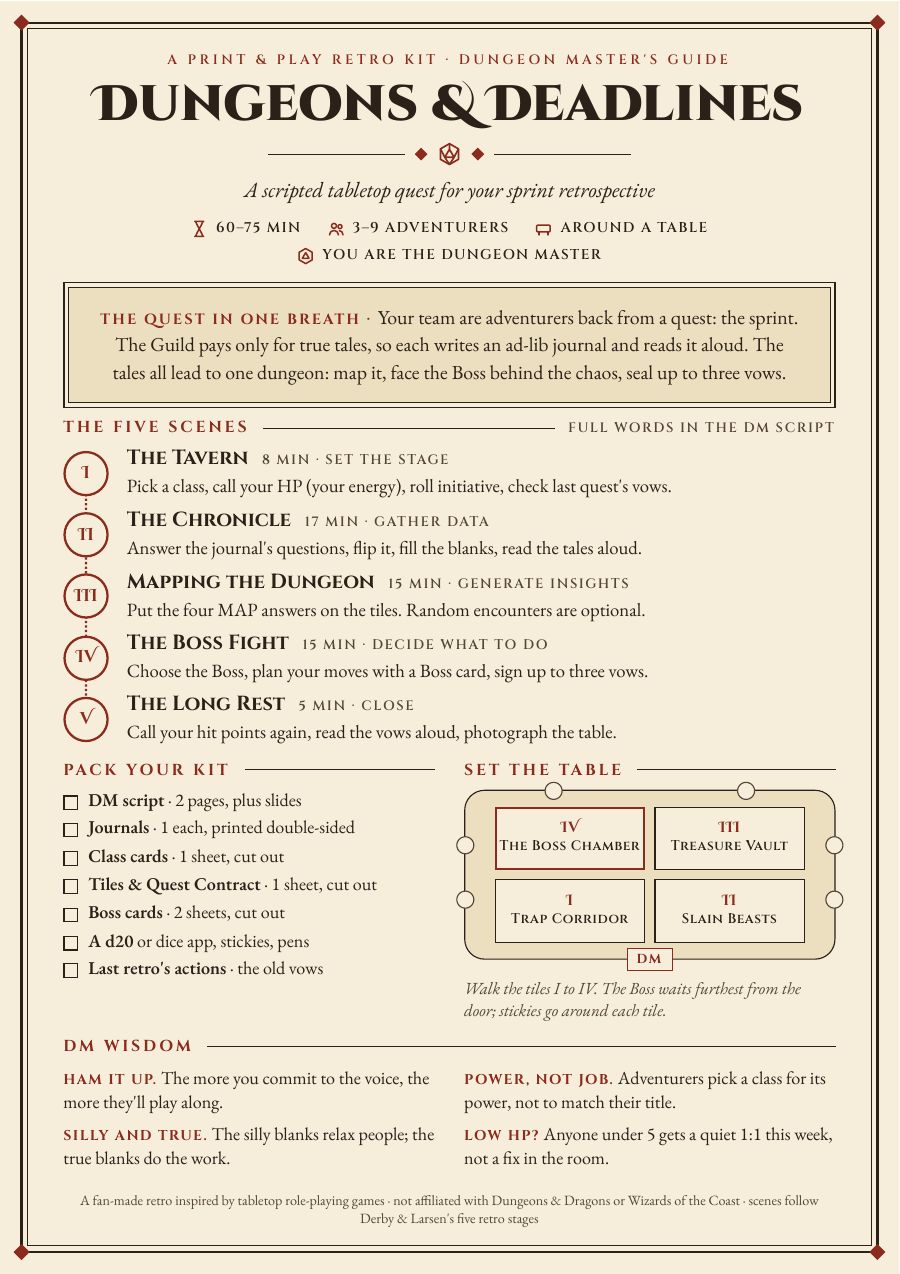
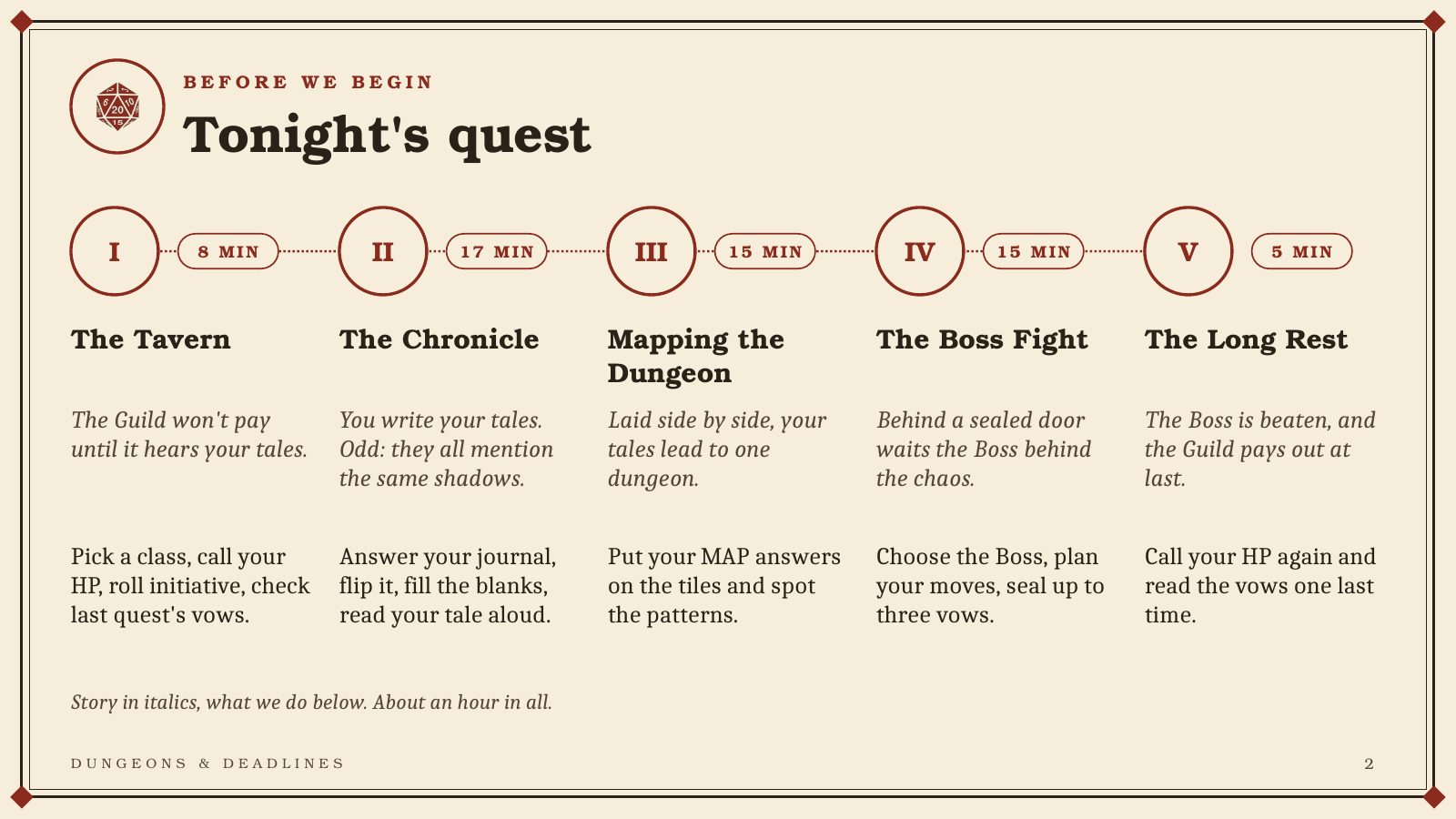
Dungeons & Deadlines turns a retrospective into a quest in five scenes. Your team are adventurers back from a quest, which was the sprint. The Guild only pays for true tales, so each adventurer fills in an ad-lib journal and reads their tale aloud. The tales all lead to one dungeon. The party maps it, faces the Boss behind the chaos, and seals up to three vows in a Quest Contract.
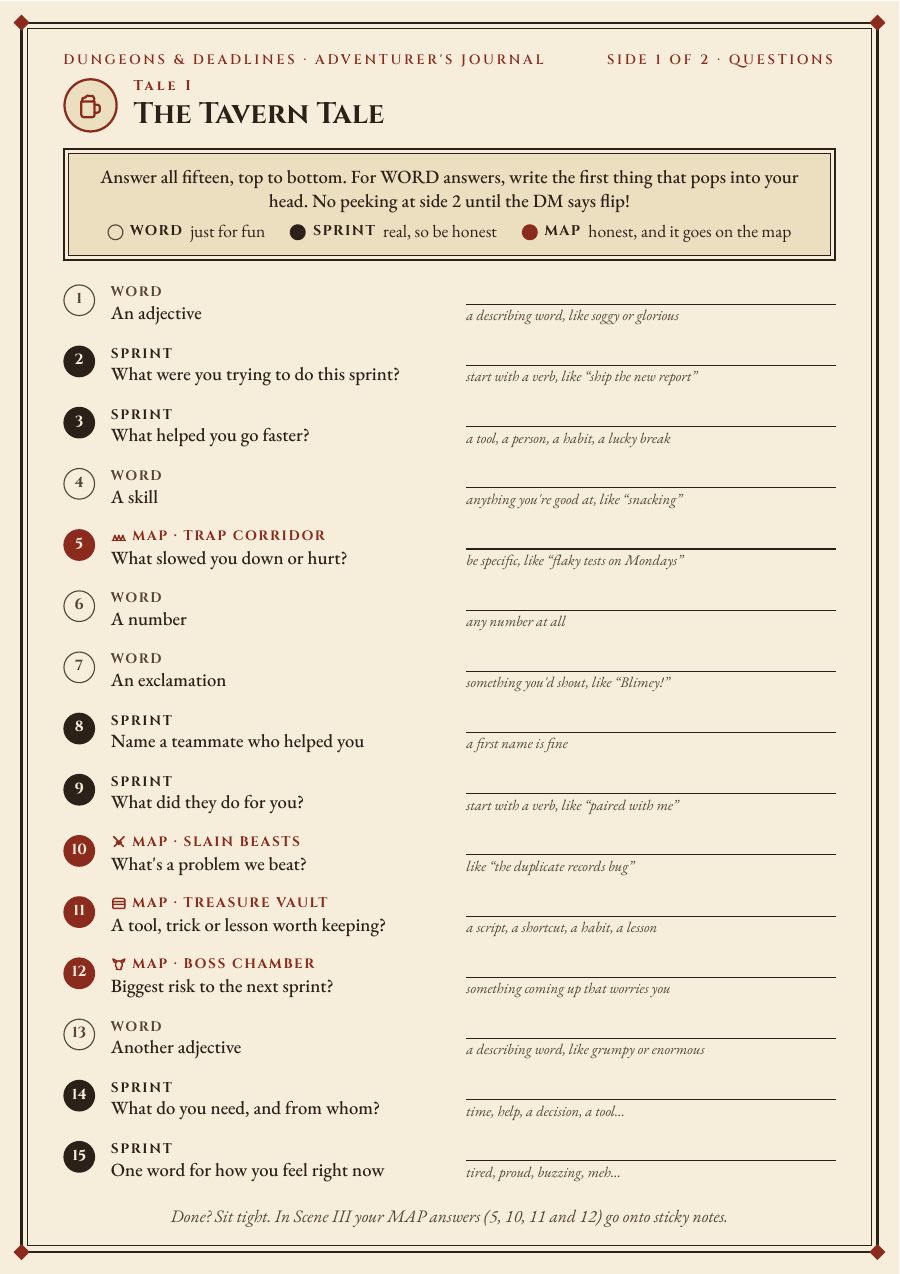
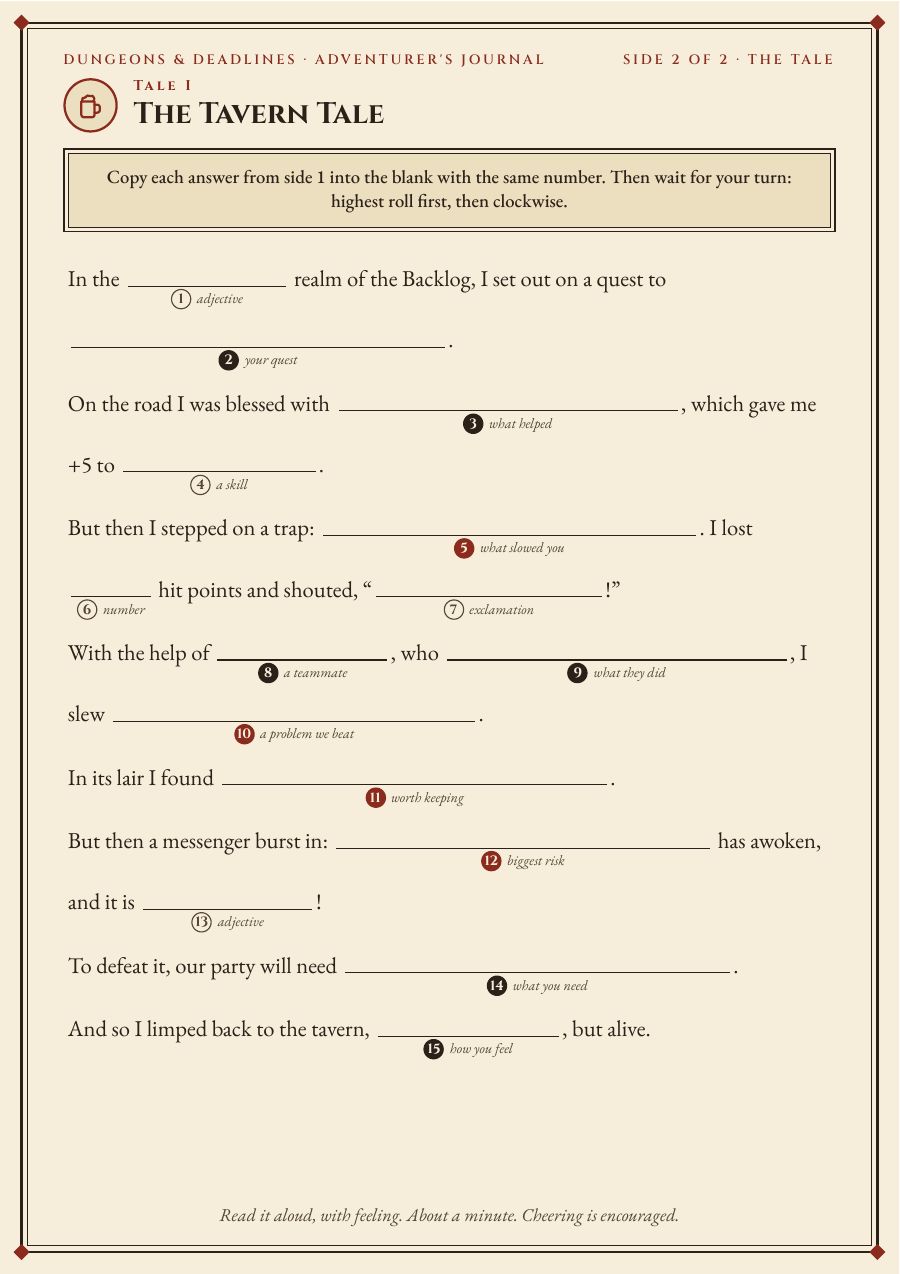
The journal carries the retro. Side 1 has fifteen questions. Some are just for fun: an adjective, a number, something you’d shout. The rest are about the sprint: what you were trying to do, what helped, what slowed you down, who helped you and what you need. Nobody sees side 2 until the DM says flip. Then each answer is copied into the blank with the same number, and everyone reads out a ridiculous story with their real sprint inside it.
The DM guide has a line for it: “The silly blanks relax people; the true blanks do the work.”
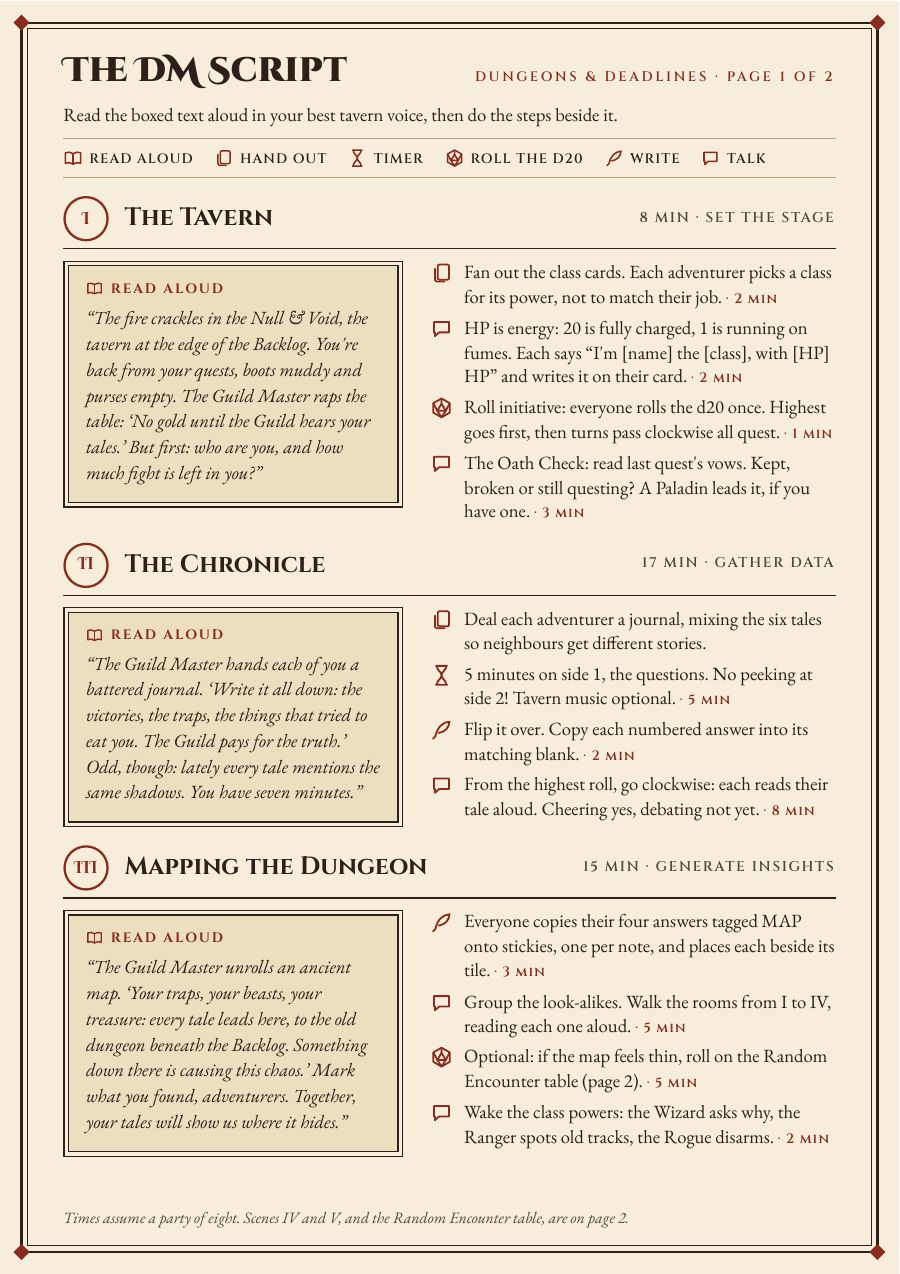
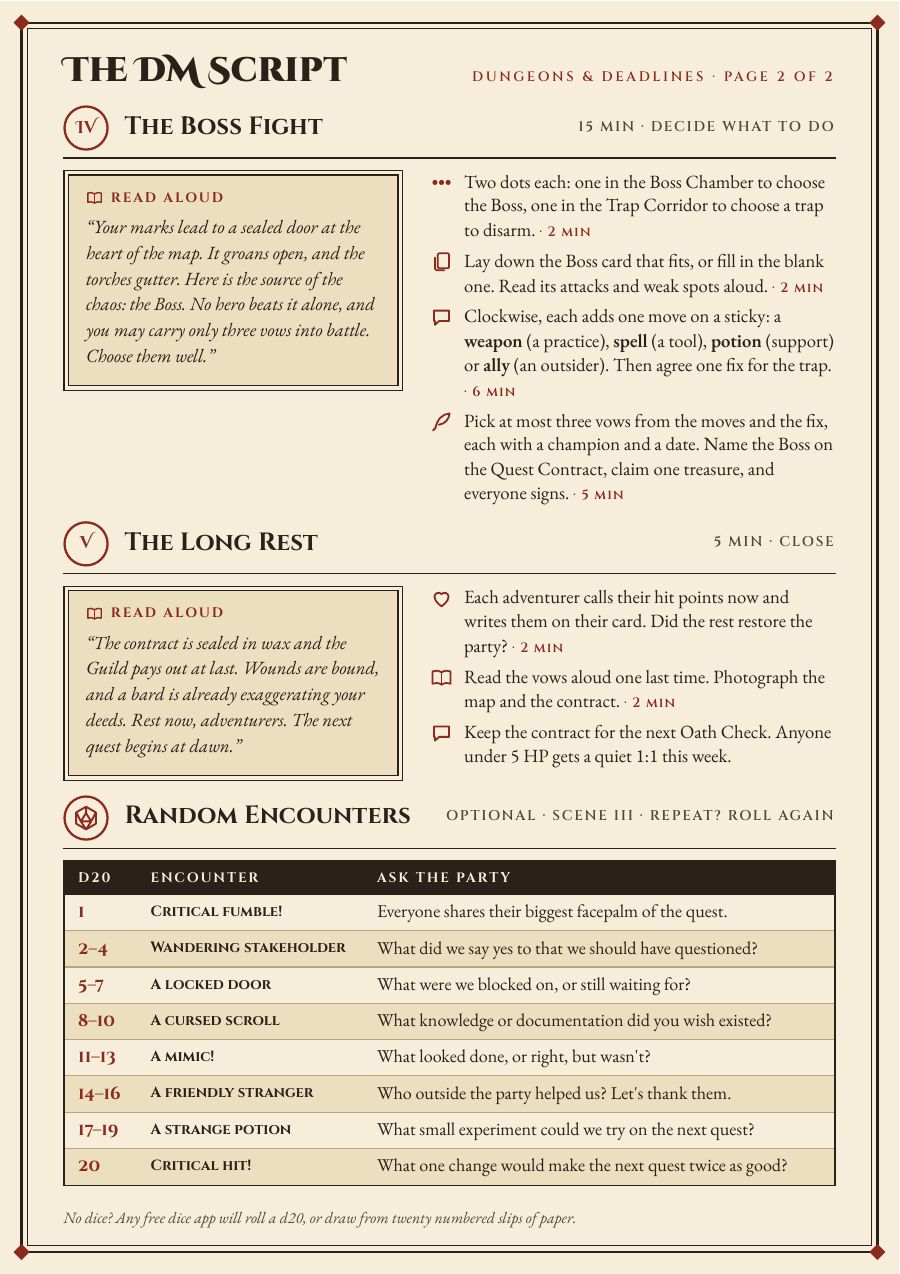
The whole session is scripted. The DM script has boxed text to read aloud for each scene, with the steps to run beside it, and the slides carry the same text in their presenter notes.
The Five Scenes
| Scene | Time | What happens |
|---|---|---|
| I. The Tavern | 8 min | Pick a class, call your hit points (your energy, out of 20), roll initiative, and check last quest’s vows |
| II. The Chronicle | 17 min | Answer the journal’s questions, flip it, fill in the blanks, and read the tales aloud |
| III. Mapping the Dungeon | 15 min | Copy the four MAP answers onto stickies and place them by the tiles. Group them, walk the rooms, and wake the class powers |
| IV. The Boss Fight | 15 min | Vote for the Boss and for one trap to disarm, plan your moves around the Boss card, and sign up to three vows |
| V. The Long Rest | 5 min | Call your hit points again, read the vows aloud, and photograph the table |
The scenes add up to an hour for a party of eight. The kit says to allow 60 to 75 minutes.
Under the theme, the five scenes are the five phases from Esther Derby and Diana Larsen’s Agile Retrospectives: set the stage, gather data, generate insights, decide what to do, and close.
The Dungeon
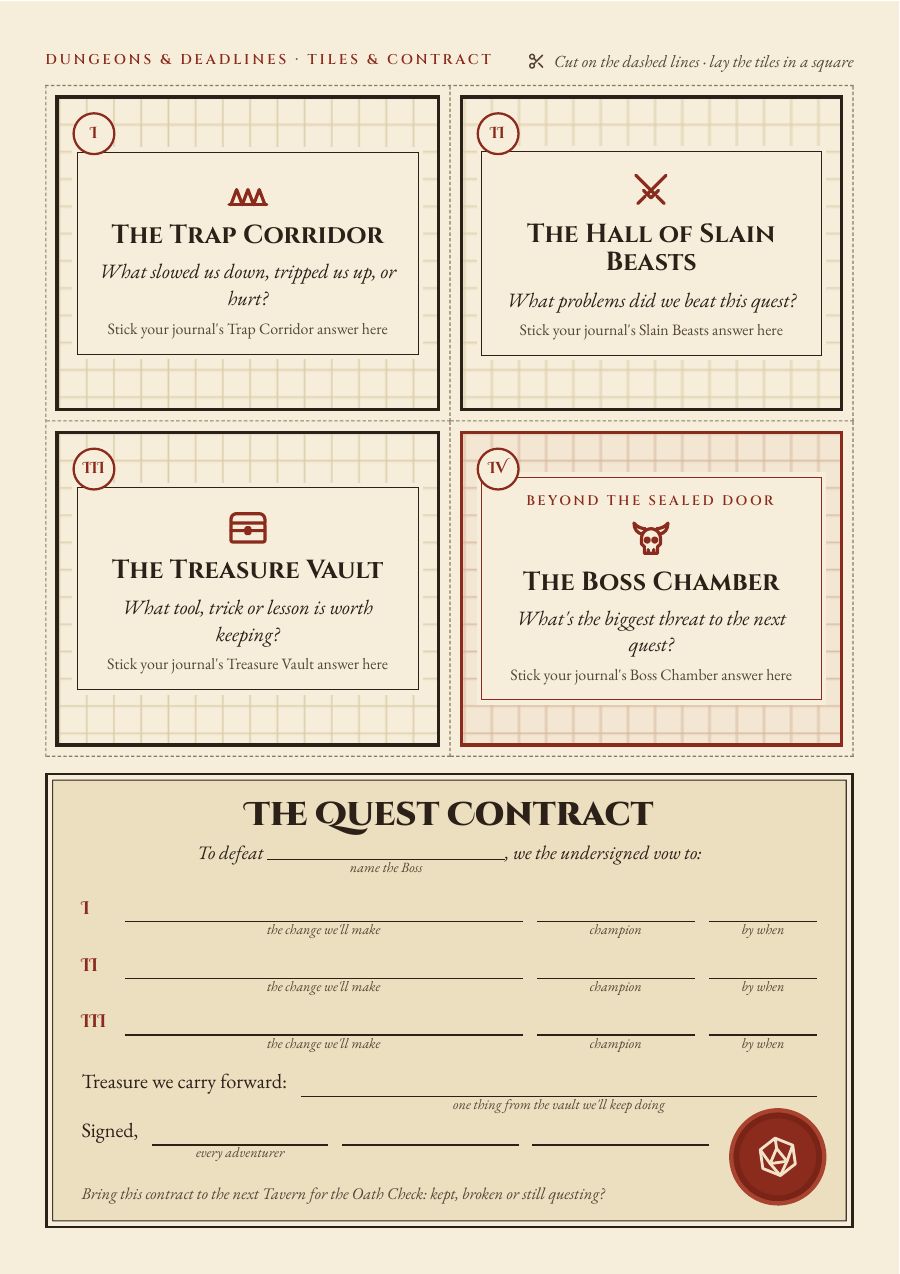
Four tiles laid in a square make the map. Every journal has four MAP answers, one for each room.
| Tile | The question |
|---|---|
| I. The Trap Corridor | What slowed us down, tripped us up, or hurt? |
| II. The Hall of Slain Beasts | What problems did we beat this quest? |
| III. The Treasure Vault | What tool, trick or lesson is worth keeping? |
| IV. The Boss Chamber | What’s the biggest threat to the next quest? |
If the map looks thin, the DM script has an optional Random Encounter table. Roll a d20. On 11 to 13 it’s a mimic, and the party answers “What looked done, or right, but wasn’t?”
Hit Points and Classes
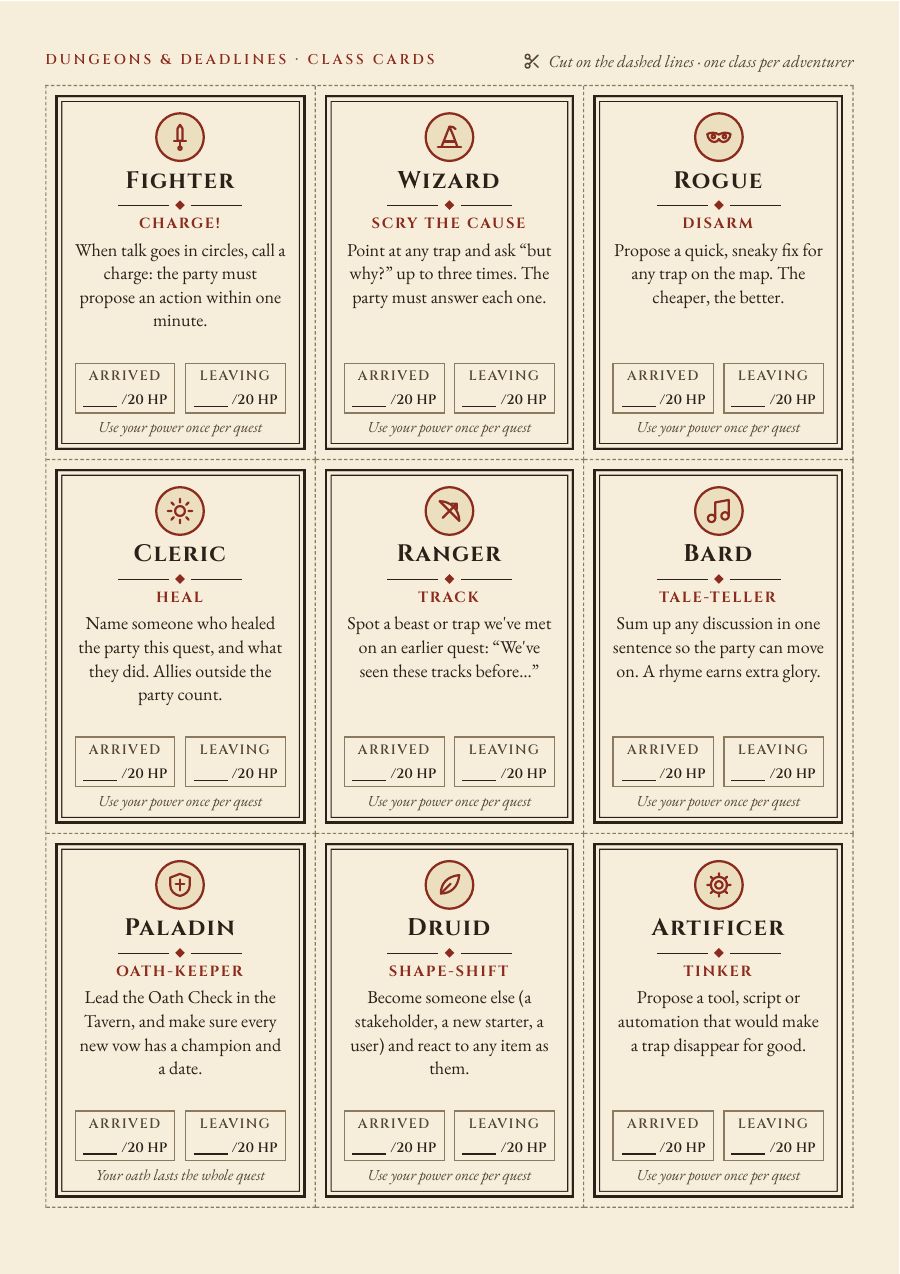
Hit points are the check-in. Each adventurer calls their energy out of 20 on the way in and again on the way out, and writes both on their class card. Nobody has to explain a number. The DM guide’s rule for a low one: anyone under 5 gets a quiet one-on-one that week, not a fix in the room.
There are nine classes. Each has one power, and people pick a class for its power, not to match their job title.
| Class | Power | What it does |
|---|---|---|
| Fighter | Charge! | When talk goes in circles, the party must propose an action within one minute |
| Wizard | Scry the Cause | Point at any trap and ask “but why?” up to three times |
| Rogue | Disarm | Propose a quick, sneaky fix for any trap. The cheaper, the better |
| Cleric | Heal | Name someone who healed the party this quest, and what they did |
| Ranger | Track | Spot a beast or trap from an earlier quest: “We’ve seen these tracks before…” |
| Bard | Tale-teller | Sum up any discussion in one sentence so the party can move on |
| Paladin | Oath-keeper | Lead the Oath Check, and make sure every new vow has a champion and a date |
| Druid | Shape-shift | Become a stakeholder, a new starter or a user, and react to any item as them |
| Artificer | Tinker | Propose a tool, script or automation that would make a trap disappear for good |
The Oath Check comes in the first scene. Last quest’s vows are read out, and the party calls each one kept, broken or still questing.
The Bosses
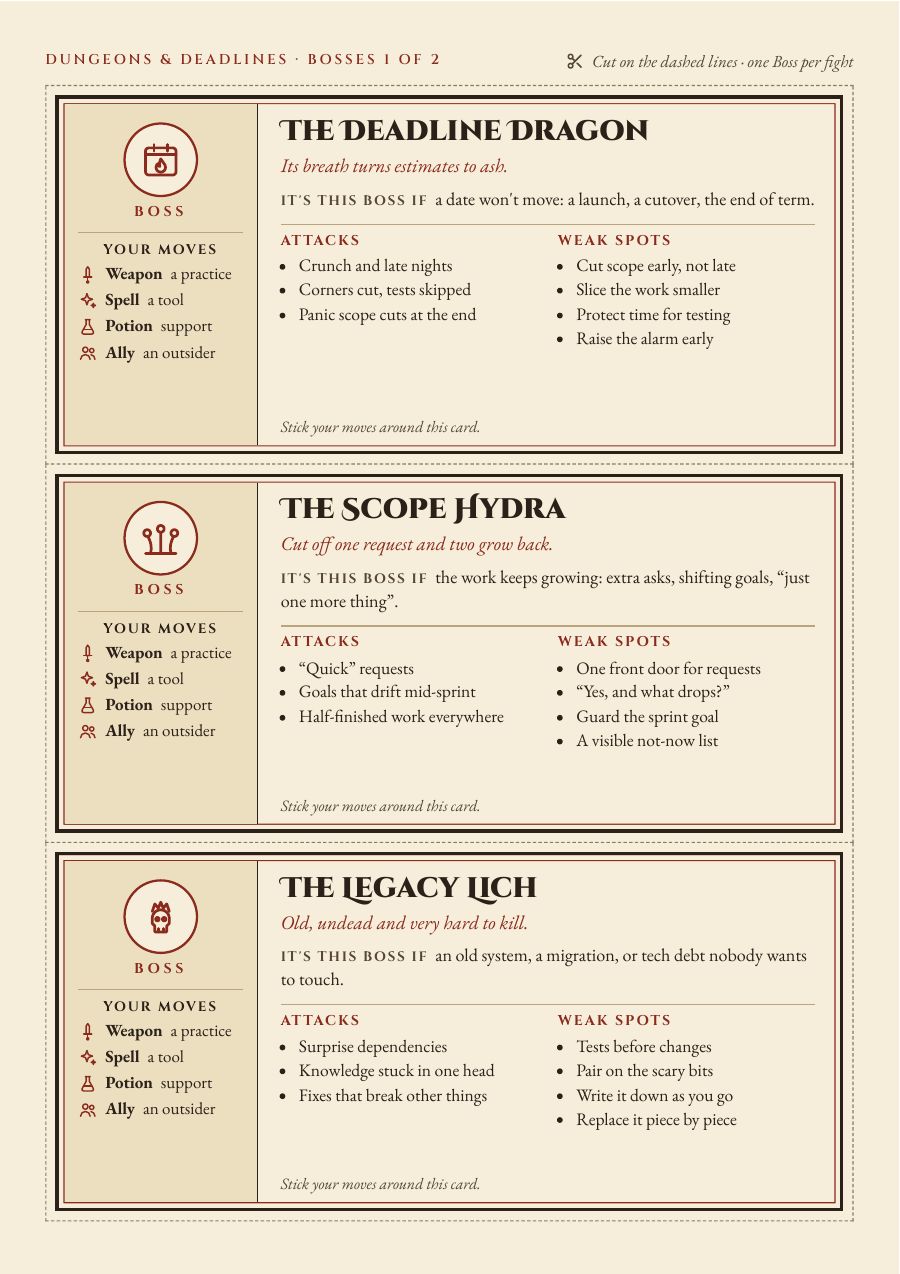
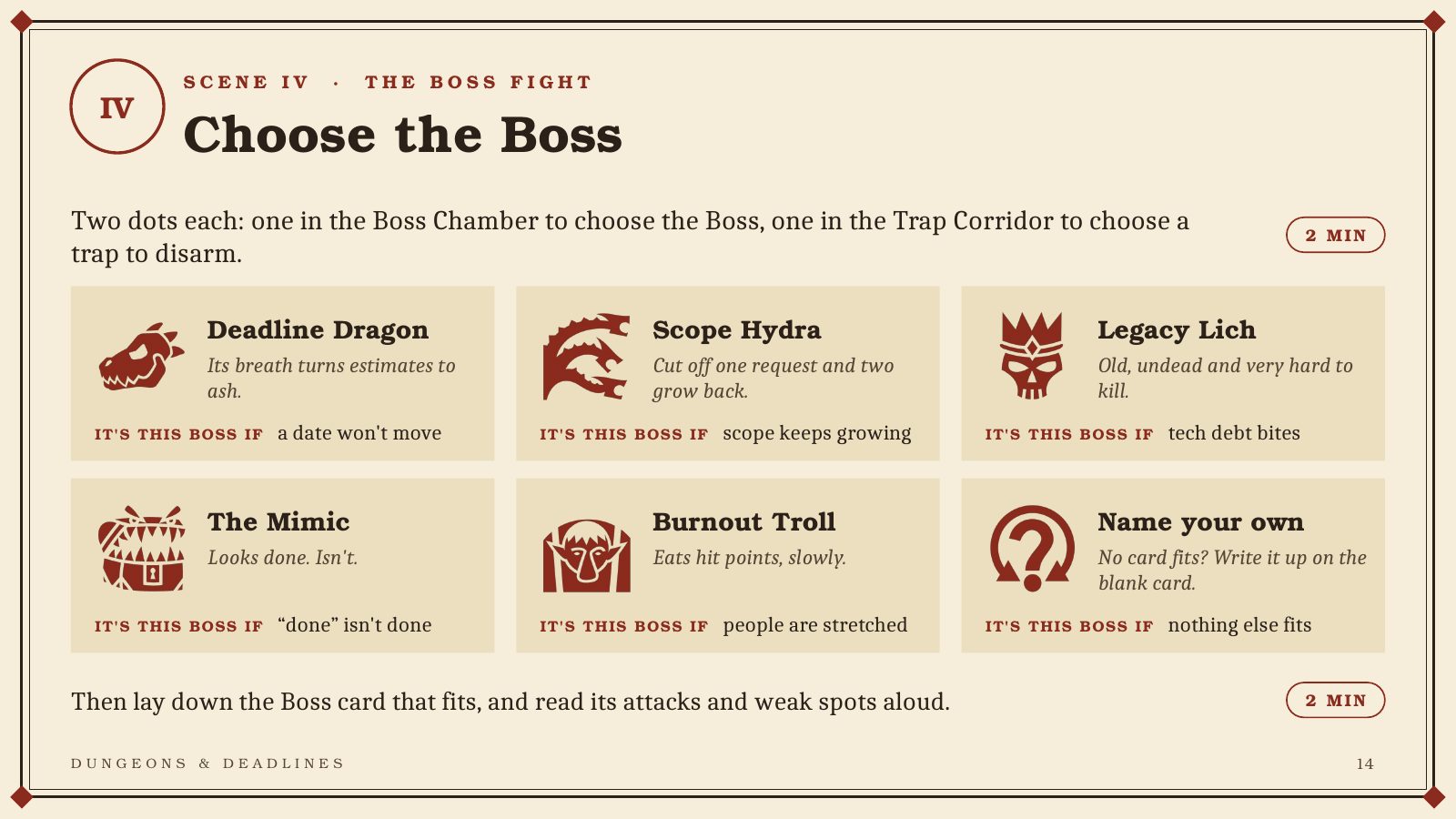
The dungeon leads to a Boss. The party votes on the biggest threat to the next quest, lays down the Boss card that fits, and reads its attacks and weak spots aloud.
| Boss | It’s this Boss if |
|---|---|
| The Deadline Dragon | A date won’t move: a launch, a cutover, the end of term |
| The Scope Hydra | The work keeps growing: extra asks, shifting goals, “just one more thing” |
| The Legacy Lich | An old system, a migration, or tech debt nobody wants to touch |
| The Mimic | Work looks finished but isn’t: wrong numbers, silent failures, rework |
| The Burnout Troll | People are stretched: too much on the go, one person holding it all, leave coming up |
There’s a blank card for a Boss of your own. Each adventurer then adds one move on a sticky: a weapon (a practice), a spell (a tool), a potion (support) or an ally (someone outside the team). The vows come from those moves and the fix for the trap. Three at most, each with a champion and a date, signed by everyone on the Quest Contract.
What’s in the Download
| File | Size | What’s in it |
|---|---|---|
| DM Kit (PDF) | 7 pages | The Dungeon Master’s guide, the two-page DM script, nine class cards, the four tiles, the Quest Contract, five Boss cards and a blank one |
| Adventurer’s Journals (PDF) | 12 pages | Six tales, each a double-sided sheet: the questions on side 1, the tale on side 2 |
| Slides (PowerPoint) | 19 slides | The quest on screen, scene by scene, with the read-aloud text in the presenter notes |
The six tales are The Tavern Tale, The Dragon’s Hoard, The Haunted Mine, The Sea Voyage, The Wizard’s Tower and The Royal Tournament. Deal them out so neighbours get different stories.
A Look Inside
Eight of the nineteen printed pages. Click one to see it full size.
And two of the nineteen slides.
What You’ll Need
- The DM script (or the slides), and one journal each, printed double-sided
- The class cards, tiles, Quest Contract and Boss cards, cut out
- A d20, or a dice app
- Stickies and pens
- The actions from your last retro, for the Oath Check
- A table everyone can sit around
When It Fits
Dungeons & Deadlines is for 3 to 9 people around a table.
It’s the most to prepare of the three kits: nineteen pages to print, and four sheets of cards and tiles to cut up. It also asks the most of whoever runs it. The DM guide’s first piece of advice is to ham it up, because the more you commit to the voice, the more the team will play along.
For a first retro with a team, the slide notes say to skip the Oath Check and give the time to the tales.
Where It Comes From
I’ve run a retro as a D&D encounter before, and wrote about it in Rolling for Initiative. Dungeons & Deadlines scripts the whole thing, so the DM doesn’t have to improvise.
D&D-themed retros are nothing new, and Miro’s template gallery has several. The icons in the slides are by Lorc, Delapouite and contributors at game-icons.net, used under CC BY 3.0.
It’s a fan-made retro inspired by tabletop role-playing games. It isn’t affiliated with or endorsed by Dungeons & Dragons or Wizards of the Coast.
Download
Download Dungeons & Deadlines - Free
The download goes through Payhip’s checkout, at $0. How your details are used: Privacy.
Related post: Rolling for Initiative, on what Dungeons & Dragons taught me about leading a team.
The other two kits are Retro Kart, a racing retro on a wall, and Retros Against Humanity, a card game with anonymous answers.
Why I made the three kits, and what games can and can’t fix in a retro: The Same Retro Gets the Same Answers.
Using It
It’s free. Print it, cut it up and run it with your team, at work included.
Please don’t sell it, or put it inside something you sell. If someone else wants a copy, send them this page.